1
/
of
8
SKU:10210008
M-TAC
M-Tac Cross Bag Slim Elite
M-Tac Cross Bag Slim Elite
Regular price
$ 1,970.43 MXN
Regular price
Sale price
$ 1,970.43 MXN
Unit price
/
per
Tax included.
- Envío gratis**
**Envío gratis en compras superiores a $800 pesos Mx.
Couldn't load pickup availability
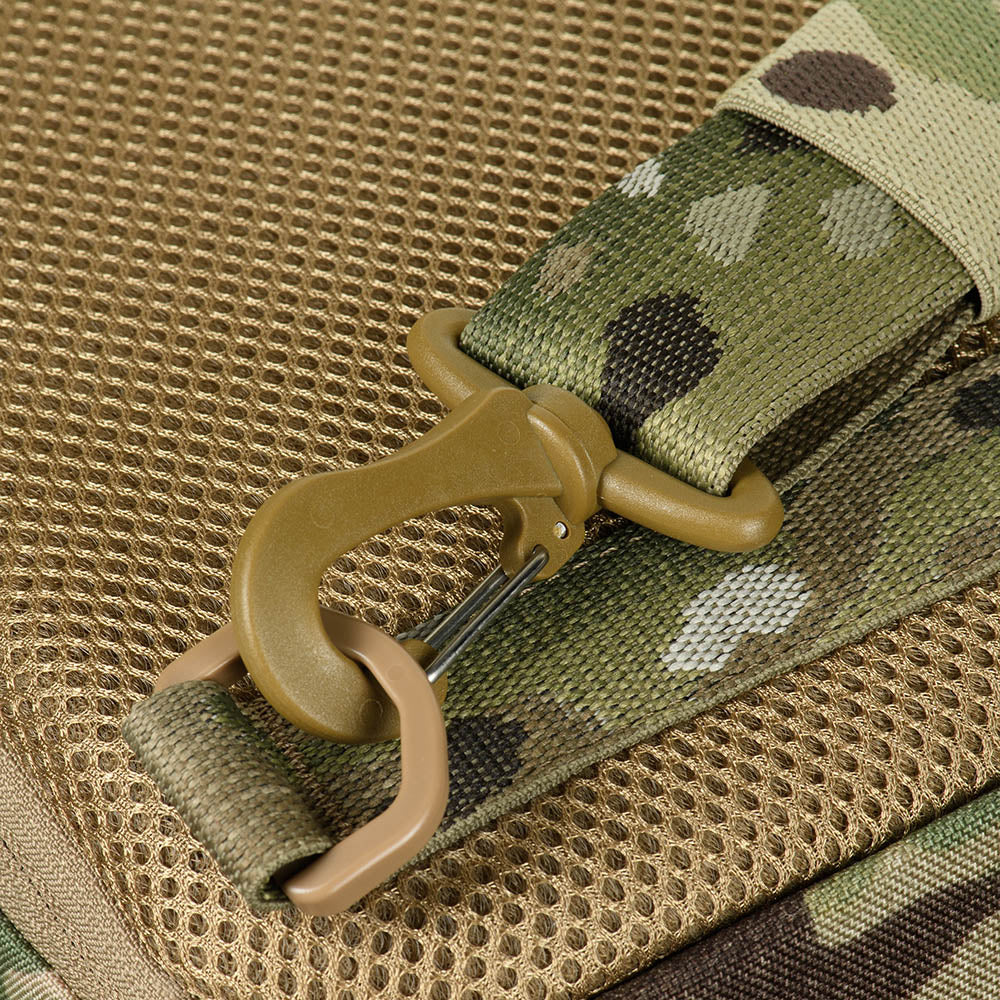
M-Tac's Cross Bag Slim Elite is a successful combination of a single strap bag and a small backpack. This model has a stylish appearance and thought-out functionality. Made of Cordura 500 , heavy-duty, durable, and easy to clean material. Zippers and buckles by YKK and Woojin , two world leaders in the production of accessories. The bag has one adjustable shoulder strap and a MOLLE interface that allows attaching additional gear. Cross Bag Slim Elite has 3 main compartments for the most convenient storage of all your essentials. The AquaGuard front zip pocket is perfect for documents. Also, this model has a secret pocket for the hidden carrying of weapons. Velcro inner wall allows attaching a holster or modular organizer inserts. The bag is conveniently located on the body and doesn't take up much space. This accessory will definitely appeal to all connoisseurs of convenience and practicality. Materials: Cordura 500 Hardware: WJ, YKK Due to its unique qualities Cordura is widely used in tactical equipment of military, law enforcement and special forces. It is mainly materials with linear density of 1000d and 500d. Linear density - is the ratio of weight of the thread of matter and its length. It is measured in denier. This unit of measurement is mainly used for nylon products. Accordingly, the higher this value, the thicker and heavier the fabric. The physical and technical characteristics of CORDURA 1000D fabric are very high, breaking load is about 3000 N, breaking load is about 150 N. The abrasion resistance is over 50,000 cycles. It is used for clothes, covers, pouches. Be it a tactical backpack, pouches or jacket.Products made of CORDURA materials will undoubtedly pass the test of time and distance. CORDURA is durability, reliability and style. In terms of strength, it is beyond any competition. Camouflage "MULTICAM" was developed by the American company Crye Precision in collaboration with the U.S. Army Soldier Systems Center, commonly known as the U.S. Army Natick Labs. Creating the MULTICAM pattern took over eight years of expeditions, scientific research, data analysis, and practical field tests. It was designed to serve as a universal camouflage solution for the American army. The need for a new camouflage became evident after Operation Desert Storm in Iraq. At the time, the camouflage patterns in use, such as Woodland for forest terrain and Tri-Color Desert for desert operations, failed to provide adequate concealment for soldiers. Each operation still required specialized camouflage, complicating supply logistics and decreasing soldier safety. Even after introducing a new universal digital camouflage (Digital) during operations in Afghanistan and Iraq, the situation did not significantly improve. It became clear that a single universal pattern was necessary, one that would allow a soldier to blend into any terrain and at any distance from an observer. The goal was to create camouflage that worked equally well against various backgrounds, including vegetation, desert, rocky terrain, urban buildings, and ruins, under different lighting conditions and in any climate throughout the year. How does this camouflage work? It seemed almost impossible to achieve such a versatile pattern. However, the designers utilized the limitations of human vision and the structure of our eyes to their advantage. In theory, for camouflage to be effective at long distances, it should consist of large, blurred spots. At closer ranges, especially against backgrounds of foliage and vegetation where the human eye detects small objects more clearly, the pattern should incorporate small, rounded elements of the dominant background. The developers found that the predominant backgrounds across most regions of the globe share similar gradients of green and brown. An important revelation was that black, which is commonly used in camouflage patterns worldwide, does not actually appear in nature. By integrating their findings and conducting computer simulations that layered over a thousand images, the developers successfully created the MULTICAM pattern. Near Infrared (NIR) technology is utilized by the US Department of Defense to minimize detection by NIR electro-optical sensors. These sensors do not detect infrared radiation. NIR uniforms are made from a special fabric that helps soldiers maintain a temperature similar to that of the surrounding landscape, making them harder to spot. Additionally, NIR technology reduces light reflection, making the uniforms less visible in low-light conditions
Share